
Carts will be delivered to homes from August 24 to September 25, 2026.
More details about cart delivery will be shared closer to that time.
This website uses cookies to enhance usability and provide you with a more personal experience. By using this website, you agree to our use of cookies as explained in our Privacy Policy.
Find answers to common questions about Norfolk County's new waste collection program.
Carts will be delivered to homes from August 24 to September 25, 2026.
More details about cart delivery will be shared closer to that time.
Can I have my cart dropped off at a different time or can I pick it up?
No. Unfortunately, we’re not able to accommodate requests for specific delivery dates or alternate pick-up options.
If you expect to be away during this time, we recommend arranging for a neighbour, friend, or family member to move the carts from the end of your driveway to a secure location near your home once they’re delivered.
Can I request a different sized cart?
The cart change request period ran from April to June 2026 and is currently paused to allow for deliveries from August 24 to September 25, 2026. Cart change requests will be available again beginning December 1, 2026, at no cost. Beginning April 1, 2027, a fee will apply to new cart change requests.
The following cart options are available:
Do I need to buy my new carts?
No. Garbage and green carts will be delivered to each property this summer at no additional cost.
Where should I store my carts?
Carts must be stored on your property in a location that does not obstruct sidewalks or roadways.
What if my cart is damaged or gets broken?
Property owners will be able to request cart repairs. Watch for more information this fall.
What happens if I move? Do my carts come with me?
No, each cart has a serial number that is assigned to the property.
When moving to a new home, leave your carts at your old home for the new residents to use.
If you are moving to a newly constructed home, you will need to contact ServiceNorfolk at 519-426-5870 or 226-NORFOLK, extension 0, to arrange for delivery of waste carts to your new home. Requests should be made two weeks before moving in to ensure the carts can be delivered before your new home’s first scheduled collection day.
If you are moving into a resale home, use the carts that are already at your new home. If the carts at your new home are not suitable for your family’s needs, are damaged, or there are no carts at your new home when you move in, please contact ServiceNorfolk at 519-426-5870 or 226-NORFOLK, extension 0.
If you are a tenant moving into a rental property, please use the carts that are already at your new home. If the carts are not suitable for your household’s needs, please contact your landlord, property owner or property management company, as only the property owner is permitted to request a cart exchange.
Norfolk County is launching a County-wide organics program for weekly organic waste collection to divert this material from landfills.
How much of Norfolk’s waste currently includes organic material?
A recent waste audit found that over 40% of residential garbage in Norfolk is organic material that could be composted. This includes food scraps, tissues, and other biodegradable items.
By using the new green bin program, residents can help divert this material from landfills, reduce environmental impact, and support a more sustainable waste system.
Review the 2024 Norfolk County Urban and Rural Waste Composition Audit (PDF).
Will I receive an organics cart?
Yes. Each household will receive an organics cart and a small kitchen bin.
Do I have to receive a green (organics) cart?
Yes. Delivery of the green cart is mandatory for any property receiving Norfolk County waste collection services. The garbage and organics carts are owned by Norfolk County and assigned to your property.
Curbside audits show 40-45 percent of Norfolk County's curbside garbage is organic waste that could be diverted from our landfill. The new green cart will help get food and organic waste out of the garbage.
No, because when food waste goes to a landfill, it is buried without oxygen under more garbage. In these conditions, it breaks down very slowly and actually produces methane, a powerful greenhouse gas that contributes to climate change. Due to a lack of oxygen, food and other materials can remain mostly intact for years, rather than fully decomposing.
Composting food waste is different. Food waste breaks down naturally with oxygen and can be turned back into healthy soil to help grow new food, creating a more sustainable, circular system instead of just adding more waste to the landfill.
I already use a backyard composter. Why do I need to use the green organics cart?
While home composting is a great way to reduce waste and lower your household’s carbon footprint, municipal composting programs offer the ability to compost items not suitable for home composters, such as meat, bones, dairy, and food-soiled paper. These programs also offer industrial-scale processes that can produce large amounts of consistently high-quality compost in less time.
By incorporating the organics cart program into your household’s already environmentally friendly waste management practices, you can further increase the amount of organic waste your household diverts from landfills.
What can go in the organics cart?
What to put in the organics cart:
Can I use compostable bags in the organics carts?
Yes. Certified compostable bags are accepted inside the organics cart.
It is recommended to line your kitchen container (which comes with your organics cart) with either certified compostable bags/liners or with newspaper. Those bags/liners can then be placed inside your green cart.
You can buy kitchen bags and liners at:
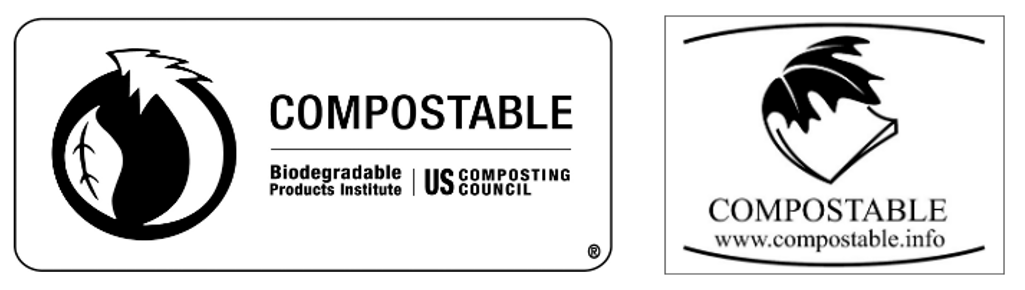
Certified bags/liners must display either the BPI or BNQ logo to be accepted in Norfolk County's green cart. Look for these symbols to make sure the bags are compostable:
Are the stickers placed on fruits and vegetables at the grocery store compostable?
No, these stickers are not compostable as they are typically made from plastic and glue that will not break down. Stickers should be removed before placing fruits and vegetables in the organics cart or, better yet, look for and purchase fruits and vegetables without these stickers to avoid the problem altogether.
Does the organics cart have a lock to prevent animals from getting in?
Yes. The organics cart is designed to be secure and will have a gravity lock to keep the bin secure from animals.
Does the organics cart come with a smaller container for under the sink?
Yes. A kitchen container will be provided with the organics cart. Residents are encouraged to use the small kitchen bin to collect scraps and transfer the scraps to their organics cart.
What are the dimensions of the organics kitchen bin?
The small organics kitchen bin measures approximately 9" L x 12" W x 9" H. It holds approximately 7 litres of kitchen scraps.
Can I put my kitchen container at the curb for collection?
No. Kitchen containers are for indoor use only and will not be collected. Empty the contents into your green cart and place only the green cart at the curb for collection. Norfolk County's automated collection trucks are designed to collect green carts only.
What is the new garbage collection schedule?
Garbage will be collected biweekly using automated carts provided by Norfolk County.
Read more about the new collection schedule, or use our online tool to look up the new collection schedule for your property.
What is the new garbage limit?
Starting Monday, September 28, 2026, garbage collection will be completed using carts. Review the standard garbage and organics carts that will be delivered this summer, and their sizes.
Only waste placed entirely inside the cart, with the lid fully closed, will be collected.
Can I buy an additional cart for my property?
No. Additional carts can not be purchased. Read more about the standard cart sizes and quantities above.
Can I place extra bags or waste beside the cart or purchase tags?
No. Bag tags will not be available. Excess waste will not be collected if placed beside the cart. Additional waste must be taken to designated disposal facilities.
Won’t my garbage smell only being collected every other week?
To reduce smells, residents should use the green bin for organic waste. Adding baking soda to garbage carts can also help reduce smells. Cleaning carts regularly is also recommended.
Diapers are non-compostable and must be placed in your regular garbage cart.
Norfolk County recognizes that for households with multiple children in diapers, a single standard garbage cart may not be sufficient. Eligible households can apply for a large garbage cart or a second standard garbage cart. To see if your household qualifies, and to apply, visit Applying for waste exceptions.
How can I dispose of pet waste?
Pet waste is non-compostable and must be placed in your regular garbage carts. Pet waste should be securely bagged to reduce odours and prevent contamination of other waste streams.
Pet waste cannot go into the organics cart.
What if I generate more waste due to special circumstances?
Norfolk County recognizes that some households may produce more waste due to unique circumstances, such as:
Norfolk County recognizes that for households with multiple children in diapers, a single standard garbage cart may not be sufficient. Eligible households can apply for a large garbage cart or a second standard garbage cart. To see if your household qualifies, and to apply, visit Applying for waste exceptions.
Will rural homes that place waste across the road continue to do this under the new program?
Yes. Garbage and organics collection will continue on the side of the road where your waste is currently collected. In rural areas, where homes are farther apart, this approach helps reduce unnecessary travel, lowering costs and reducing wear and tear on collection trucks.
If there is any change to your collection location or set‑out requirements, Norfolk County will contact affected residents directly with clear instructions before the new program begins.
We understand that some rural residents may have properties with long driveways, which can pose a challenge.
For rural properties, residents may choose to keep their carts near the end of the driveway and bring materials to them as needed. On collection day, carts must be placed at the edge of your driveway at the municipal road for pickup.
What if I’m unable to move my garbage or organics carts due to age or mobility issues?
Norfolk County’s new waste collection program will only collect waste using the supplied carts. There are no alternative collection methods available.
For many residents, carts are easier to use than carrying bags because they roll on wheels, reducing the need to lift. If you need help moving your cart to the curb, we recommend asking a family member, neighbour, or someone in your community, such as a student, to assist you on collection day.
Will my old garbage cans be collected when the new carts are delivered?
No. Residents are encouraged to repurpose their old garbage cans for use around the home, such as for storage or yard work.
If you no longer need your old garbage cans, they can be taken to a County transfer station for disposal. Please note that regular disposal fees will apply.
Can I swap carts with a neighbour if I want a different size?
No. Each cart has a unique serial number that is assigned to your property. Carts cannot be switched between properties. If you need a different cart size, you must request an exchange through Norfolk County.
How does waste collection work for farm properties with bunkhouses?
Under the new curbside collection program, farm properties with bunkhouses can receive two large garbage carts (360 litres each) that are collected every other week. Read more about how to request two large garbage carts.
If your farm operation and bunkhouse generate more garbage than will fit into two large carts, Norfolk County cannot collect the extra waste. In this case, the property owner must arrange for private waste collection for the excess garbage.
This requirement is consistent with the current Waste Management By-law, which limits garbage collection from farm properties to the equivalent of eight bags per collection. Properties that exceed this limit today are already required to arrange for private collection services. The new program maintains this approach, with cart limits replacing bag limits.
Recycling will continue on a weekly basis using the two-bin system, but it’s important to note that this service is no longer operated by Norfolk County. Under Ontario’s Extended Producer Responsibility (EPR) program, producers are now responsible for managing and funding the residential recycling system.
While the current collection method remains the same, changes may occur after the full transition to EPR. Norfolk County will continue to share updates as the program evolves.
Read more about Recycling.
Will yard waste collection change?
Yes. Yard waste collection will be expanded to run for 14 weeks annually and include nine additional hamlet areas.
Current areas:
An additional nine hamlet areas will be added:
How do I dispose of bulky items?
Bulky items will continue to be collected monthly by appointment. Fees apply. Read more about Bulky Item Pick-Up.
How can commercial properties join the new waste collection program?
Commercial properties must register to participate in the new waste collection program.
Registration will be available again starting on September 28, 2026.
According to MPAC classification, churches or 'places of worship' have a 700-series MPAC code, which makes them a commercial property. Read more on the MPAC website.
Churches can receive municipal waste collection if they register as a commercial property and if they can fit their garbage needs into one large (360L) garbage cart and one 120L green organics cart.
Registered commercial properties can also request a smaller garbage cart, or a second garbage and/or organics cart if needed.
Are condominiums in Norfolk County eligible for municipal waste collection?
Residential condominium developments may be eligible for curbside waste collection, but they must first submit an application. Norfolk County will review site plans and check that the property meets the technical guidelines. To request an application, email waste@norfolkcounty.ca or call 519-426-5870 or 226-NORFOLK, extension 0.
Condominiums that include commercial or industrial units, or buildings with multiple residential units (such as apartment‑style buildings), are not eligible.
What technical guidelines does a condominium need to meet?
To qualify, the property must meet all requirements in Norfolk County’s Technical Guidelines for Condominium Waste Collection, including:
Why aren’t common collection points allowed for condos?
Common collection points, where multiple residential units collectively set out their waste, often create safety and access issues for collection trucks. The new guidelines require waste to be set out at individual unit driveways to support safe, consistent collection practices.
What happens if a condo cannot meet the technical guidelines?
If a condominium corporation does not meet the required guidelines, it must use private waste collection.
How does a condo corporation apply for municipal collection?
Condo boards or property managers can request an application by emailing waste@norfolkcounty.ca or call 519-426-5870 or 226-NORFOLK, extension 0.
County staff will assess site plans and alignment with technical guidelines to determine if the development is eligible for curbside waste collection services.
Will units in duplexes, triplexes and other multi-unit buildings receive carts?
Units in duplexes, triplexes, and buildings with up to six units will each receive their own garbage and organics cart.
The number of garbage and organics carts delivered to multi-unit properties will be determined based on the property’s MPAC classification. For example:
Units that are not registered with MPAC WILL NOT receive garbage or organics carts.
Read more on the MPAC website.
Buildings with seven or more units must arrange for private collection.
Does Norfolk County provide waste collection for social housing properties?
Services vary depending on the type of building. Multi‑residential social housing properties not already using private waste collection services will need to coordinate private collection arrangements before September 29, 2026.
What type of social housing units are eligible to receive curbside waste collection services?
Social housing units with individual driveways on municipal streets may use curb-side collection if they follow Norfolk County’s residential waste rules. Social housing units with internal private roadways must meet Norfolk County’s Technical Guidelines for Condominium Waste Collection Services to be eligible for curbside waste collection services.
Why is the cost of waste collection increasing?
The previous curbside waste collection contract was awarded in 2017. Since then, costs have risen significantly due to inflation, labour shortages, higher vehicle and equipment costs, and market pressures across Ontario.
How much will the new program cost?
The estimated cost for the first full year of the new program is $7.99 million, which is $2.75 million less than originally projected. This will result in a 2.8% increase to the net levy requirement.
Also see the question above: Is automated collection cost-effective?
When will the new cost take effect?
The increase will be phased in:
Are carts included in the cost?
Yes. The County will invest $5,029,000 to procure garbage and green bin carts. This cost will be fully funded by investment income from the Legacy Fund, meaning no impact to the tax levy.
What is automated waste collection?
Automated collection uses mechanical arms on trucks to lift and empty carts, reducing manual labour and improving efficiency.
Why is Norfolk County switching to automated collection?
Automated collection offers several benefits: lower long-term costs, improved worker safety, faster and more consistent service, and reduced litter and animal interference due to secure carts.
Is automated collection cost-effective?
Yes. Even after factoring in the cost of carts, automated collection was the lowest bid received among all service models evaluated.
The chart below is from the report to Council and shows the cost difference between manual and automated garbage and green bin collection.
Scroll the table horizontally on smaller screens to see all columns.
| Method and frequency of pickup | Bid per tonne | Recommended budget based on bid | Difference compared to staff recommendation ($ and %) |
|---|---|---|---|
| Weekly Manual Garbage and Weekly Automated Green Bin | $325.40 | $4,504,700 |
$963,200 27% |
| Weekly Automated Garbage and Weekly Automated Green Bin | $325.40 | $3,802,800 |
$261,300 7% |
| Bi-Weekly Manual Garbage and Weekly Automated Green Bin | $325.40 | $4,259,800 |
$718,300 20% |
| Bi-Weekly Automated Garbage and Weekly Automated Green Bin | $254.13 | $3,541,500 | Staff recommendation |
Will automated collection affect service quality?
No. In fact, it is expected to enhance service reliability and reduce missed pickups, especially in adverse weather conditions.
Why is Norfolk County focusing on waste reduction?
Landfills across Ontario are approaching capacity, with an estimated 10 years of landfill space remaining province-wide. Without significant changes, municipalities may face higher costs and environmental impacts from transporting waste longer distances or developing new landfill sites.
Norfolk County does not have its own landfill and relies on a private landfill within Ontario for its disposal needs.
Will the program help reduce landfill use?
Yes. The 2024 waste audit showed that 42–46% of residential garbage is organic waste that could be diverted through composting. By introducing a green bin program and reducing the garbage bag limit, Norfolk County aims to divert more waste from landfill, extend landfill lifespan, and reduce greenhouse gas emissions.
What happens if we don’t reduce waste?
If waste continues to grow unchecked, Norfolk may face higher disposal costs, environmental risks, and limited landfill options in the future.
Is this part of a provincial initiative?
Yes. The Government of Ontario wants communities to send less waste to landfills and recycle and compost more. Norfolk County’s new waste collection program supports this goal by:
These changes help protect the environment and follow the province’s direction to make waste management more sustainable.
How is Norfolk County responding to this direction?
Norfolk County’s new waste collection program aligns with Ontario’s goals by launching a county-wide green bin program, expanding yard waste collection, reducing the residential garbage limit, and continuing recycling under the producer responsibility framework.
Will there be more changes in the future?
Possibly. As provincial policies evolve, Norfolk County will continue to adapt its waste management strategies to meet environmental and regulatory goals.
Why did Norfolk County receive only one bid for the new waste collection contract?
Norfolk County followed a formal and transparent procurement process in accordance with its Purchasing Policy. The Request for Proposal (RFP) was publicly issued and accessible to all interested vendors. While eight companies initially obtained the bid documents, only one proposal was ultimately submitted. Several vendors cited challenges such as:
These factors reflect broader industry pressures, including inflation, labour shortages, and equipment costs. Although the County cannot compel vendors to bid, the process ensured fairness, transparency, and value for taxpayers.
Subscribe for waste change updates
The information provided on this page is subject to change as Norfolk County finalizes the details of the new waste collection program.
Subscribe to "2026 Waste Changes" for news and updates sent right to your email inbox.
Contact Us
ServiceNorfolk
50 Colborne Street South
Simcoe, Ontario
N3Y 4H3
Phone: 519-426-5870 or 226-NORFOLK, extension 0

Find and View

Apply or Register

